925 Sterling Silver Jewelry Quality Checklist for B2B Buyers
Table of Contents
For jewelry brands, wholesalers, retailers, and e-commerce businesses, 925 sterling silver jewelry quality depends on more than silver purity. Before approving a bulk shipment, buyers should check the material, hallmark, surface finish, plating, stone setting, soldering, dimensions, weight, packaging, and final inspection results.
This sterling silver jewelry quality checklist provides a practical 10 point inspection framework for B2B buyers sourcing 925 silver jewelry from manufacturers.
10 Point 925 Sterling Silver Jewelry Quality Checklist at a Glance
| Check | What to Verify | Pass Standard |
|---|---|---|
| Silver purity | 925 specification, material documentation, testing | Meets the agreed material specification |
| Hallmark | 925 or S925 marking | Clear, correctly positioned, and matches the specification |
| Surface finish | Scratches, pits, black spots, polishing | No unacceptable visible defects |
| Plating | Color, coverage, thickness, adhesion | Matches the approved sample and agreed specification |
| Stone setting | Security, alignment, gaps | Stones are secure and properly positioned |
| Soldering | Joints, connections, excess solder | Clean and structurally sound |
| Dimensions | Length, width, thickness, size | Within the agreed tolerance |
| Weight | Finished product weight | Within the agreed specification |
| Packaging | Anti tarnish protection and packing details | Matches approved packaging requirements |
| Final QC | Sampling inspection and defect classification | Meets the agreed inspection standard |
The exact acceptance criteria should be confirmed between the buyer and manufacturer before production. A good inspection checklist should be based on the approved sample, CAD drawings, material specifications, plating requirements, and purchase order.
1. Silver Purity: Verify the 92.5% Standard
The first step in checking 925 sterling silver quality is confirming the material specification.
925 sterling silver normally contains 92.5% silver, with the remaining portion made up of alloying metals that improve strength and workability. This composition is widely used for commercial jewelry production.
For B2B orders, do not rely only on the appearance of the finished jewelry. Ask the manufacturer how the silver material is verified before production.
What B2B Buyers Should Check
- Confirm that the purchase specification states 925 sterling silver.
- Request relevant material documentation when required.
- Ask whether material purity is tested using XRF or another appropriate method.
- Check that the tested material corresponds to the production batch.
- Confirm any additional requirements, such as nickel free specifications, before production.
A hallmark such as 925 can support material identification, but a visual inspection alone cannot establish the exact metal composition. For higher value orders, buyers can arrange independent material testing when appropriate.
For a detailed explanation of 925 silver composition and hallmarks, see our guide to what does 925 mean on jewelry.
2. Hallmarks: Check 925 or S925 Marking
A 925 or S925 marking is commonly used to identify sterling silver jewelry, but marking requirements can vary between markets and product categories.
For international B2B orders, buyers should confirm the applicable requirements for the destination market rather than assuming that one marking rule applies everywhere.
What to Inspect
Check the following:
- 925 or S925 marking where specified
- Marking clarity
- Correct position
- Consistency across the approved sample and bulk production
- Whether the marking matches the agreed product specification
The stamp should be readable and professionally applied without damaging the jewelry.
For branded collections, also check whether the manufacturer’s mark, brand logo, or other required markings have been placed according to the approved sample.

3. Surface Finish: Check for Visible Defects
A high quality sterling silver jewelry piece should have a surface finish consistent with the approved sample.
During inspection, buyers should look for visible defects that could affect appearance, customer satisfaction, or resale quality.
Common Surface Defects to Check
- Scratches
- Pits or pinholes
- Black spots
- Uneven polishing
- Rough edges
- Casting marks
- Surface bubbles
- Uneven texture
- Visible discoloration
Inspection should be performed under suitable lighting and compared with the approved sample.
The important question is not whether every handmade jewelry piece is visually identical, but whether the bulk production remains within the agreed quality specification.
This distinction is particularly important for wholesale jewelry because acceptable tolerances should be established before production rather than decided after shipment.
4. Plating: Check Color, Coverage and Thickness
Many 925 sterling silver jewelry designs use rhodium, gold, or rose gold plating. In these products, the quality of the final finish depends on more than color.
B2B buyers should confirm measurable plating specifications before placing a bulk order.
What to Check
- Plating color
- Surface coverage
- Plating thickness where specified
- Color consistency between pieces
- Exposed base metal
- Plating adhesion
- Surface protection or e-coating where required
For gold plated or vermeil jewelry, confirm the karat and target plating thickness with the manufacturer.
For example, two products may both be described as “18K gold plated” while having different plating thicknesses and finishing specifications. The term alone does not define the complete quality specification.
You can learn more about protective finishing in our e-coating process guide.


5. Stone Setting: Check Security and Alignment
For gemstone and CZ jewelry, stone setting should be checked before bulk shipment.
Loose or poorly aligned stones can lead to customer complaints, returns, and product damage.
Stone Setting Inspection Checklist
Check for:
- Loose stones
- Uneven prongs
- Open gaps around the stone
- Incorrect stone positioning
- Damaged stones
- Excess adhesive where applicable
- Inconsistent stone alignment
- Uneven setting depth
The inspection method should reflect the type of setting.
For example, prong settings require attention to prong security and alignment, while bezel settings require attention to the surrounding metal and stone seating.
The approved sample should be the main reference for appearance and construction.
6. Soldering: Check Joints and Connections
Soldering is particularly important for jewelry containing multiple components, chains, links, clasps, or assembled structures.
Poor soldering can create both visual defects and structural problems.
Check the Following
- Visible gaps at joints
- Weak connections
- Excess solder
- Uneven soldering
- Discoloration around joints
- Sharp edges
- Components that move incorrectly
The finished joint should be clean and structurally secure while maintaining the intended appearance of the approved sample.
For pieces exposed to repeated movement, such as bracelets and chain components, structural inspection is especially important.
7. Dimensions: Compare with the Approved Sample
One of the simplest ways to identify production variation is to compare bulk jewelry with the approved sample or CAD specification.
Depending on the product, buyers may need to check:
- Overall length
- Width
- Thickness
- Ring size
- Chain length
- Stone position
- Component dimensions
- Logo position
Use an Agreed Tolerance
There should not be one universal dimensional tolerance for every type of jewelry.
A thin pendant, a ring, and a chain component may have different practical tolerances because of their construction and manufacturing process.
Therefore, buyers should confirm the acceptable tolerance before bulk production.
The approved sample, technical drawing, or CAD file should be used as the reference point.
If a dimension is commercially important, include the target measurement and acceptable tolerance directly in the purchase specification.
8. Weight: Compare Against the Approved Specification
Product weight can affect material cost, product feel, shipping calculations, and customer expectations.
For this reason, weight should be checked against the approved sample or agreed production specification.
What to Check
- Finished product weight
- Weight consistency between samples
- Weight variation within the production batch
- Metal weight where specifically required
- Whether hollow or lightweight construction matches the approved design
Do not automatically apply the same percentage tolerance to every jewelry design.
Instead, agree on an acceptable weight range based on the product’s size, structure, material, and manufacturing process.
For private label and OEM projects, weight should ideally be confirmed during sample approval.
9. Packaging: Check Anti Tarnish Protection
Quality inspection does not end with the jewelry itself.
Packaging can affect how 925 sterling silver jewelry arrives at the buyer’s warehouse and how it is stored before sale.
Packaging Inspection Checklist
Check:
- Anti tarnish bags or suitable protective packaging
- Individual packaging requirements
- Moisture protection where required
- Desiccant requirements where applicable
- Product labels
- Quantity per package
- Jewelry cards
- Custom boxes or pouches
- Barcode or SKU information
- Outer carton markings
For long distance international shipments, confirm the agreed packaging method before production.
The packaging specification should be approved together with the jewelry sample so that both product and presentation remain consistent.
10. Final QC: Agree on an AQL Sampling Standard
AQL, or Acceptable Quality Limit, is commonly used as a statistical sampling approach for inspection. It helps buyers and suppliers define how many pieces should be inspected and how defects are classified.
However, AQL 2.5 should not be treated as a universal quality standard for every jewelry order.
The buyer and manufacturer should agree on the inspection level, sample size, defect classification, and acceptance criteria before shipment.
A Practical Final Inspection Process
A final inspection may include:
- Confirm the correct purchase order and product specifications.
- Select samples according to the agreed sampling plan.
- Check material and markings.
- Inspect appearance and surface finish.
- Check plating and stone setting.
- Measure critical dimensions.
- Check product weight where required.
- Inspect packaging and quantities.
- Record defects by severity.
- Compare the results with the agreed acceptance criteria.
For larger orders, new suppliers, or high value collections, buyers may also arrange an independent third party inspection before shipment.
The most important point is to agree on the inspection standard before production, rather than negotiating acceptable defects after the goods are completed.
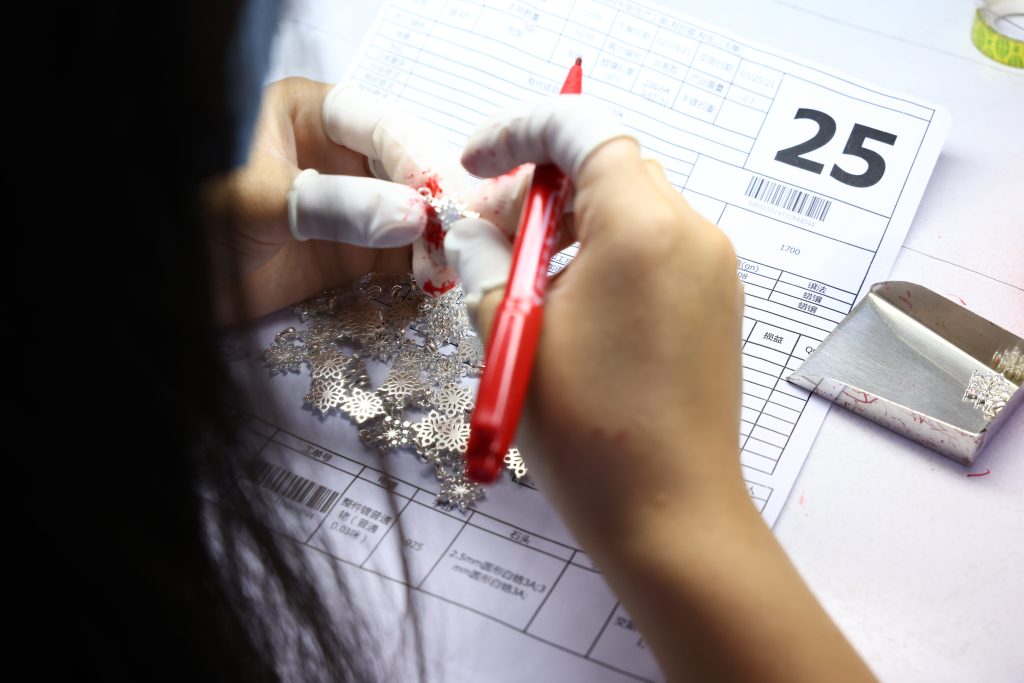
How to Inspect 925 Sterling Silver Jewelry Before Shipment
A practical B2B inspection process can be divided into three stages.
1. Review the Approved Sample
Before bulk production starts, confirm:
- Material
- Dimensions
- Weight
- Plating
- Stone specifications
- Logo
- Surface finish
- Packaging
The approved sample becomes the physical reference for bulk production.
2. Inspect the Bulk Production
During final inspection, compare production pieces with the approved specifications.
Focus on the characteristics that can directly affect customer experience:
- Material authenticity
- Appearance
- Structural strength
- Plating
- Stone security
- Dimensions
- Weight
- Packaging
For brands ordering custom jewelry, keeping a written inspection specification can make communication with the factory much easier.
3. Arrange Independent Inspection When Needed
For new suppliers, large orders, or products with strict quality requirements, an independent inspection company can provide an additional verification layer.
A third party can inspect the finished goods against the buyer’s specifications and agreed sampling plan before shipment.
If you are still evaluating suppliers, our guide on how to choose a silver jewelry manufacturer covers the factors B2B buyers should review when selecting a manufacturing partner.
What Should B2B Buyers Include in a 925 Silver Jewelry Quality Specification?
A useful purchase specification should be more detailed than simply stating “925 sterling silver.”
At minimum, consider documenting:
| Specification | What to Define |
|---|---|
| Material | 925 sterling silver and any alloy requirements |
| Hallmark | 925, S925, logo, or other required markings |
| Dimensions | Key measurements and acceptable tolerances |
| Weight | Target weight or agreed range |
| Plating | Type, color, karat and thickness where applicable |
| Surface | Required finish and acceptable defects |
| Stones | Type, size, color, setting and security |
| Logo | Position, method and dimensions |
| Packaging | Bags, boxes, cards, labels and quantity |
| QC | Inspection method and acceptance criteria |
This documentation reduces ambiguity between the buyer and manufacturer and gives both sides the same reference during production.
Why Quality Inspection Matters for Wholesale Jewelry
For B2B buyers, product quality affects more than the appearance of individual pieces.
Inconsistent quality can lead to:
- Customer complaints
- Returns and replacements
- Inventory losses
- Additional inspection costs
- Delayed product launches
- Brand reputation issues
A structured inspection process helps identify production problems before the goods leave the factory.
At Endless Jewellery, quality control covers material verification, product dimensions, stone security, surface finishing, plating consistency, and final appearance inspection. These checks are part of the production process for custom jewelry orders.
For brands developing custom collections, you can also explore our OEM silver jewelry manufacturing from design to delivery service.
Frequently Asked Questions
1.How can I check 925 silver jewelry quality?
Start by checking the agreed material specification, 925 hallmark, surface finish, plating, stone setting, soldering, dimensions, weight, and packaging. For higher value orders, material testing or independent inspection can provide additional verification.
2.What does 925 mean on sterling silver jewelry?
925 normally indicates that the material contains 92.5% silver, with the remaining portion consisting of alloying metals. The exact material specification should still be confirmed with the manufacturer when sourcing wholesale jewelry.
3.How do B2B buyers inspect silver jewelry before shipment?
B2B buyers can compare bulk production against the approved sample, CAD specifications, purchase order, and agreed QC requirements. Final inspection can include appearance, dimensions, weight, plating, stone setting, packaging, and sampling inspection.
4.What is AQL 2.5 in jewelry inspection?
AQL 2.5 refers to a sampling parameter used within an inspection plan. It does not by itself define the overall quality of a jewelry product. Buyers and suppliers should agree on the complete sampling plan, defect classifications, and acceptance criteria before production.
5.What should I ask a 925 sterling silver jewelry manufacturer before placing a bulk order?
Ask about material verification, hallmarking, plating specifications, quality control procedures, sampling, production lead time, MOQ, packaging, and inspection documentation. For custom projects, also confirm the approved sample and technical specifications before bulk production.
Final Checklist for B2B Buyers
Before approving a shipment of 925 sterling silver jewelry, confirm:
Material ✓ Hallmark ✓ Surface ✓ Plating ✓ Stones ✓ Soldering ✓ Dimensions ✓ Weight ✓ Packaging ✓ Final QC
The most reliable approach is to define these requirements before production and use the approved sample and written specifications as the reference for final inspection.
For jewelry brands, wholesalers, and retailers sourcing custom 925 sterling silver jewelry, a clear quality specification helps reduce misunderstandings and makes production expectations easier to manage.
Endless Jewellery provides OEM and ODM jewelry manufacturing for brands and wholesalers, including 925 sterling silver jewelry, custom design development, sampling, plating, quality inspection, and customized packaging. Our factory currently supports low MOQ production from around 30 pieces per design, with samples commonly developed within 7 to 10 days and bulk production commonly taking around 20 to 30 days after sample approval, depending on the project.
About the Endless Jewellery
This article is based on the production and quality control experience of the Endless Jewellery manufacturing team in Guangzhou, China. Endless Jewellery provides OEM, ODM, private label, and wholesale jewelry manufacturing for international brands, retailers, and jewelry businesses.
Our production capabilities include 925 sterling silver, gold plated jewelry, gold vermeil, brass jewelry, CAD development, casting, polishing, stone setting, electroplating, quality inspection, and customized packaging.
Have a jewelry design idea or some questions?